

Most organisations don’t have a safety investment problem. They have a safety measurement problem. And until that changes, safety will keep showing up in the boardroom as a compliance report instead of a strategic lever.
For years, EHS leaders have tried to convince leadership of one idea; safety is not a cost centre. It’s an investment. But here’s the uncomfortable truth in most boardrooms; that argument still isn’t landing. Not because CFOs don’t care. Because safety doesn’t show up in the language they operate in.
You won’t find “strong safety culture” on a balance sheet. But you will find its absence, quietly distributed across multiple cost lines:
- Insurance premiums that increase year after year without a clear explanation
- Production delays attributed to “operational issues”
- Attrition costs never traced back to workplace conditions
- Incident-related downtime buried under “miscellaneous losses”
Safety isn’t missing from the P&L. It’s fragmented across it.

Lagging indicators are holding safety back
Most organisations still measure safety using two primary metrics: Total Recordable Incident Rate (TRIR), which counts recordable injuries per 100 full-time employees, and Lost Time Injury Frequency Rate (LTIFR), which measures lost-time injuries per million hours worked. Both are classified as lagging indicators for good reason.
From a CFO’s perspective, that’s backward-looking data. It’s like running a business using last quarter’s numbers alone. It tells you what has already gone wrong, not where risk is building up right now.
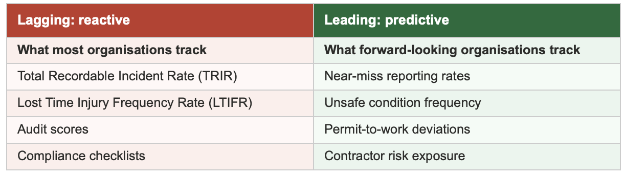
Leading indicators answer a fundamentally different question: Where’s risk building up before it becomes expensive?
Near-miss reporting rate, for instance, is a leading indicator, the more actively employees report near misses, the more proactive the safety culture. That’s the signal worth watching.
Safety culture is a financial signal
A strong safety culture isn’t just about behaviour. It’s about predictability, and predictability is what CFOs value most.
“Companies that did not adequately manage workplace safety and health performed worse financially, and investors who had accounted for safety performance in their strategy could have increased their returns.” OSHA Business Case for Safety"
The financial link is direct. When safety culture is strong, you see consistent near-miss reporting, faster hazard resolution, fewer operational disruptions, and a more stable workforce. When it’s weak, you see the opposite: underreporting, surprise incidents, reactive firefighting, and hidden costs that surface too late to manage. The difference between the two isn’t just safety performance; it’s financial volatility.
The shift: from compliance data to decision intelligence
The next evolution of EHS isn’t more audits or stricter compliance. It’s better data connected to the outcomes that leadership already cares about. Organisations ahead of the curve are doing three things differently:
- Connecting safety data to business outcomes
Tracking incidents alongside downtime, cost of delays, and workforce productivity, not in a siloed safety report.
- Prioritising leading indicators over lagging ones
Focusing less on what happened and more on what almost happened, and what’s likely to happen next.
- Making safety visible to leadership
Translating safety data into the language of risk exposure, cost avoidance, and operational efficiency. Not reports. Insight.
The question CFOs should be asking
For CFOs, this reframes the conversation entirely. Instead of asking “how much are we spending on safety?”, the better question is: where is unmanaged risk silently costing us money?
In most organisations, the answer is: everywhere. And once safety data is connected to business outcomes, that question has a specific, measurable answer.
Safety doesn’t need better justification. It needs better visibility. Measured correctly, it becomes a lever for reducing financial volatility, a driver of operational stability, and a signal of organisational maturity. A strategic asset that’s been hiding in plain sight.
See what this looks like in practice
SafetyConnect helps EHS and operations teams move from reactive compliance tracking to proactive, data-informed safety management, with the dashboards and leading indicators that make the business case clear to leadership. Visit safetyconnect.io to get a demo.
Sources: National Safety Council Injury Facts 2023; Liberty Mutual Workplace Safety Index 2025; OSHA Business Case for Safety and Health; PMC Insurance Group / NSC safety ROI analysis.


.png)


